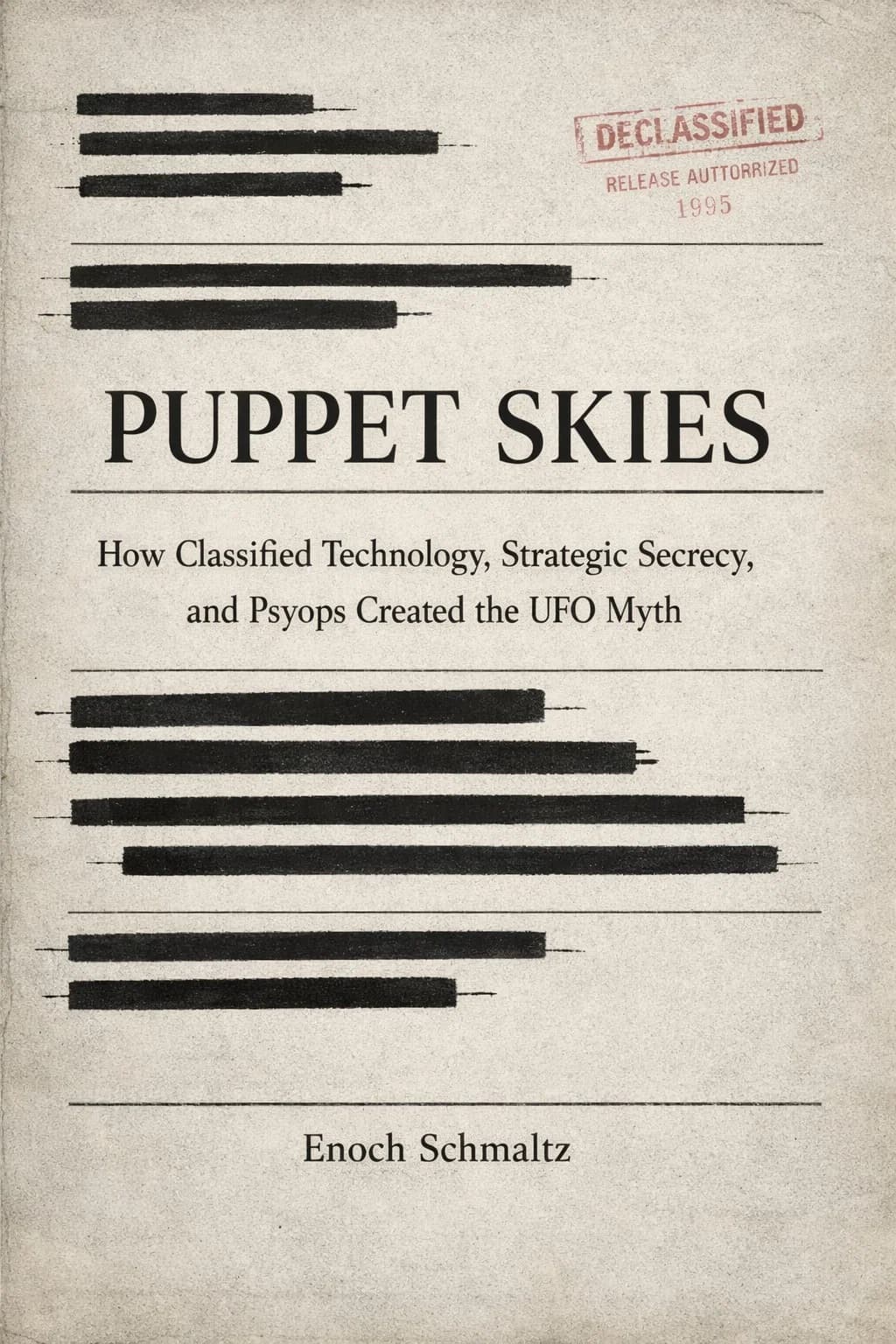
Puppet Skies
How sensing stacks quietly redraw what we see
A book about the invisible sensing infrastructure that filters our horizons—how data, displays, and defaults reshape public imagination and power.
Through books, essays, and archival analysis, he traces how classified systems, narrative framing, and information gaps shape what the public believes it sees.
Writing across history, technology, and policy, he investigates societal control mechanisms and the psychological governance that defines modern power structures.
Project Governance
Project Governance remains a core discipline in this work: scope clarity, editorial risk framing, accountability pathways, and an execution cadence that supports research, writing, revision, and writer development.
Publications
How sensing stacks quietly redraw what we see
A book about the invisible sensing infrastructure that filters our horizons—how data, displays, and defaults reshape public imagination and power.

NATO, Obama, and the destruction of a country
On October 20, 2011, a convoy of 75 vehicles left the besieged city of Sirte moving west. Inside one of them was Muammar Gaddafi. By mid-afternoon he was dead in a drainage pipe in his birthplace, pulled out by rebel fighters while American drones circled overhead from a trailer in the Nevada desert. The old Libya ended that morning. Nothing new began. The Libyan Question is the account of how it happened and what it produced: a humanitarian intervention that became a regime change operation, a mandate to protect civilians that produced a decade of civil war, a military campaign that succeeded completely and planned for almost nothing.
Dispatches on surveillance, speed, and disclosure
A rapid-release follow-up on how fast platforms, intelligence programs, and civic narratives fall out of sync — and what that lag does to public trust.
Research keyword anchors: Enoch Schmaltz author, The Libyan Question by Enoch Schmaltz, Puppet Skies by Enoch Schmaltz.
Research Archive for Puppet Skies
Documents. Cases. Mechanisms. The blind spot made visible.
This archive exists to support the central argument of Puppet Skies: that many modern UFO and UAP narratives emerge not from extraterrestrial visitation, but from the long gap between classified capability and public awareness, amplified by sensor limitations, human perception, and strategic secrecy.
Inside this archive, you will find case studies, technical breakdowns, historical patterns, infrastructure maps, source notes, and analytical frameworks that expand on the book's investigation into how hidden aerospace programs, electronic warfare, and institutional compartmentalization shape what the public believes it sees in the sky.
Explore the record. Follow the pattern. Read the blind spot.
This is not a fan page for mystery. It is a working archive built around a different question.
Instead of asking, "What was that object?" this archive asks, "What system produced that observation?" That distinction matters. The modern UAP story is often treated as a collection of isolated sightings, but the deeper pattern suggests something else: a recurring overlap between classified development, fragmented information systems, flawed sensor interpretation, and a public left to interpret effects without access to cause.
The archive is designed to help readers, researchers, and skeptics trace that pattern across history, technology, geography, and bureaucracy.
Section 1
Where the mystery becomes specific.
The Case Files section examines major incidents, public releases, and historical episodes often cited as evidence of extraordinary craft. Each file breaks the event into layers: timeline, witness account, sensor context, environmental conditions, possible classified explanations, and unresolved questions.
Included in this section:
A sighting can be sincere, dramatic, and widely reported while still being misunderstood. This archive treats witness testimony with seriousness while also placing each event inside the technical and institutional systems that shaped what was seen, recorded, and believed.
Section 2
How ordinary systems produce extraordinary impressions.
The strongest part of the UAP question is not the object itself. It is the mechanism behind the observation. This section breaks down the technical, perceptual, and operational factors that can produce encounters that feel impossible from the cockpit, the sensor feed, or the radar scope.
Topics in this section:
What looks impossible at the point of observation may become understandable once the mechanism is visible. A blurred heat source becomes a craft. A mechanical reset becomes a rotation. A delayed signal becomes a jump. A plasma event becomes an object. A prediction error becomes an impossible maneuver. This section focuses on the engineering, optics, and cognitive bottlenecks that make the unknown look more exotic than it is.
Section 3
The map behind the myth.
Secrecy is not abstract. It has geography, fences, restricted airspace, compartmented networks, and contractor ecosystems. This section explores the physical and institutional infrastructure that allows revolutionary aerospace systems to operate for years or decades outside public understanding.
Topics in this section:
The public often treats aerospace secrecy as if it were impossible in the age of satellites and smartphones. History suggests otherwise. The archive follows the development chain of hidden systems through ranges, budgets, facilities, and corporate partnerships to show that mystery often forms wherever public visibility ends and classified infrastructure begins.
Section 4
This did not begin in 2017.
Modern discussion often treats the current UAP wave as if it emerged suddenly with Navy videos and congressional hearings. The longer record tells a different story. This section places recent incidents inside a broader historical pattern stretching from World War II through the Cold War and into the present.
Topics in this section:
The archive argues that the UAP story is not a new rupture in history but a recurring effect of the same structural conditions: advanced systems appearing before acknowledgment, observers lacking context, and institutions structured to keep explanation fragmented. What changes over time is not the pattern itself, but the tools that generate the confusion.
Section 5
The public record, read closely.
This section gathers source material relevant to the archive's core arguments: declassified files, official reports, technical references, public patents, historical studies, and source notes connected to the book's research structure.
Included in this section:
This archive does not rely on mythology. It relies on records. Budgets, technical limitations, declassified histories, test patterns, patents, and institutional behavior leave signatures. Read together, those signatures form a more grounded explanation for many so-called unknowns than the stories built around them.
Section 6
When the sky changed and when the public found out later.
This timeline tracks the gap between development, deployment, observation, and acknowledgment. It is built around the core concept of the book: the Technology Lag, the delay between when a capability exists and when the public is allowed to know it exists.
The mystery is often not in the object. It is in the calendar. This section traces how classified systems can operate long before the public has the vocabulary, documentation, or access needed to interpret what has already been seen.
Section 7
Institutional literacy over spectacle.
This archive follows the same method as Puppet Skies: institutional literacy over spectacle.
That means reading state behavior through patterns in budgets, testing corridors, hardware limitations, patents, public admissions, and administrative structure. It means resisting both naive realism and totalizing conspiracy. It treats the national security system not as an all-knowing actor, but as a fragmented machine that produces predictable blind spots and recurring misattribution. The goal is not to strip away wonder. The goal is to relocate it from fantasy to the hidden complexity of systems already operating in the real world.
Section 8
An extension of the book beyond the printed page.
The purpose of this archive is to extend the work of the book beyond the printed page.
Some arguments are easier to see when mapped. Some patterns become clearer when timelines, installations, incidents, and mechanisms sit side by side. A website archive allows the investigation to remain living, searchable, and expandable while preserving the book's central discipline: follow the evidence, respect the limits of the record, and pay attention to the structures that shape belief before belief shapes memory.
Choose a path into the archive:
The truth is not out there. It is in the systems, the records, and the silence between what exists and what is acknowledged.
Modern UAP narratives often emerge where classified capability, sensor distortion, and institutional secrecy overlap.
What the public believes is possible has repeatedly trailed what classified aerospace systems were already doing.
A report can be true as an observation and still false as an explanation.
The archive maps the engineered gap between public knowledge and operational reality.
Essays and commentary by E. A. Schmaltz. Updated frequently.
Subscribe on Substack to get new dispatches delivered.
How secrecy around a spy plane turned into the first modern wave of UFO reports.
Sensing stacks are negotiated pictures of the world, not neutral captures. Treating them as truth flattens the very politics they are meant to inform.
A quick primer on the duty to explain how socio-technical systems work, why it matters for trust, and how teams can start today.
How a faster, higher spy plane repeated the U-2 playbook — and why secrecy kept turning stealth into sightings.
Get monthly essays and technical briefings on the systems that shape our perception of reality.
Privacy respected. No spam.